



Water-Cooled vs. Air-Cooled Diesel Generators: What Are the Key Differences?
Release time: 2026-11-27
Table of Contents
Diesel generators are used in a wide range of applications, from residential backup power and small commercial facilities to industrial operations and large infrastructure projects. One important design difference is the engine cooling method. Air-cooled and water-cooled systems manage engine heat in different ways, affecting equipment structure, maintenance requirements, and suitability for different operating conditions.
For buyers comparing generator sets, understanding these differences helps narrow down suitable models based on power requirements and operating environments. Hefei Yiyue Electrical Equipment Trading Co., Ltd. supplies generator sets alongside a broader range of power distribution and electrical equipment, serving applications across industries such as electric power, petrochemicals, rail transit, and manufacturing.
1. How Do Air-Cooled and Water-Cooled Diesel Generators Work?
The main difference between the two systems is how heat is removed from the diesel engine during operation.
An air-cooled diesel generator uses airflow to carry heat away from the engine. Cooling fins increase the surface area available for heat dissipation, while airflow helps prevent excessive temperature buildup. This arrangement avoids the need for a liquid coolant circulation system.
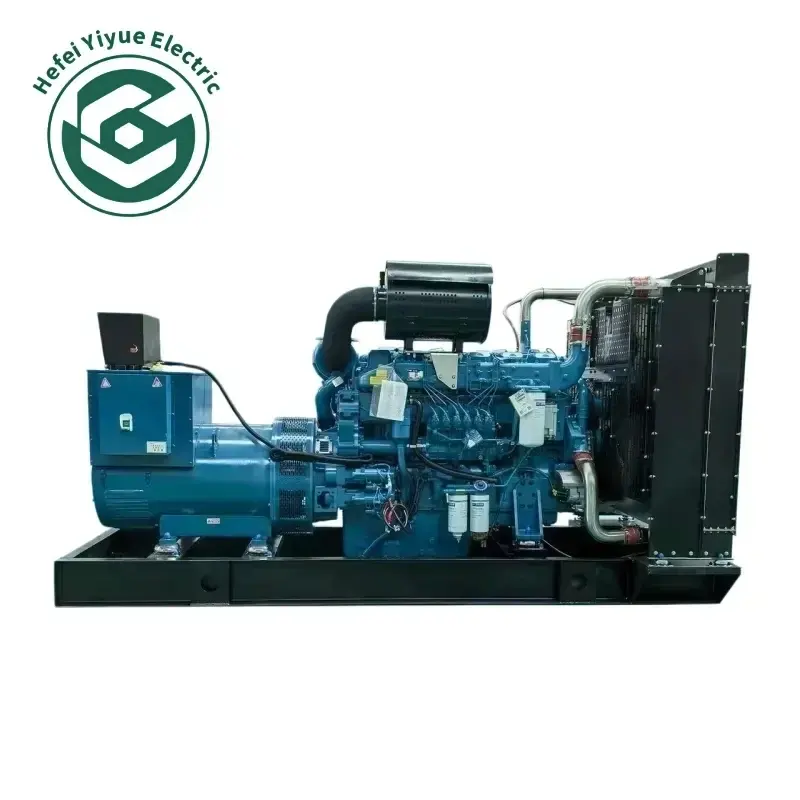
A water-cooled diesel generator uses circulating coolant to absorb heat from the engine. The heated coolant then passes through a radiator, where heat is released into the surrounding air before the coolant returns to the engine. This process helps maintain a more controlled operating temperature, particularly in larger engine configurations.
Although both systems serve the same basic purpose, their components and maintenance requirements are different.
2. Key Differences Between Air-Cooled and Water-Cooled Diesel Generators
The following table summarizes several practical differences between the two cooling methods.
| Comparison | Air-Cooled Diesel Generator | Water-Cooled Diesel Generator |
| Cooling method | Uses airflow to dissipate engine heat | Uses circulating coolant and a radiator |
| System structure | Generally simpler, with fewer cooling-system components | Includes additional components such as a radiator and coolant circuit |
| Maintenance | Requires attention to airflow passages and cooling surfaces | Requires coolant checks and inspection of the radiator and cooling circuit |
| Installation considerations | Does not require a separate liquid cooling system | Requires sufficient space and airflow around the radiator |
| Typical product examples | 2kW, 6.5kW, 8.5kW and 15kW models | 75kW, 120kW, 200kW and 250kW models |
These are general design differences rather than absolute rules. Actual performance and maintenance needs also depend on engine design, generator configuration, operating load, and the surrounding environment.
3. Air-Cooled Diesel Generators: Structure and Product Examples
An air-cooled system is often used in compact generator sets where a relatively simple engine cooling arrangement is suitable. Without a coolant circuit, the generator has fewer cooling-related components to inspect and maintain.
The product range includes several air-cooled models with different output capacities and engine configurations:
| Generator Model | Rated Power | Maximum or Standby Power | Engine Configuration | Key Features |
| 2kW Quiet Mini Diesel Generator | 2kW | 2.2kW standby | Single-cylinder, 4-stroke, air-cooled | Silent canopy, wheels and handle |
| 6.5kW Air-Cooled Diesel Genset | 6.5kW | 7.0kW maximum | Single-cylinder, 4-stroke, air-cooled, 456cc | Electric and recoil starting, AVR |
| 8.5kW Portable Diesel Power Generator | 8.5kW | 9.0kW maximum | Single-cylinder, 4-stroke, air-cooled, 498cc | Single-phase or three-phase options |
| 15kW Industrial Grade Diesel Generator | 15kW | 16.5kW maximum | Two-cylinder, 4-stroke, air-cooled, 997cc | Open-frame or optional silent canopy |
The 2kW model is designed for smaller backup and mobile power requirements. It features a silent canopy and wheel kit, while its single-cylinder engine provides a compact power solution.
The 6.5kW and 8.5kW models offer higher output capacities. Both support electric and recoil manual starting, while the 8.5kW model also provides optional single-phase and three-phase configurations. These features allow buyers to compare different electrical output requirements when selecting a portable generator.
For a higher output within the air-cooled range, the 15kW industrial-grade diesel generator uses a two-cylinder, four-stroke engine with a displacement of 997cc. Its rated output is 15kW, with a maximum output of 16.5kW.
These examples show that air cooling is not limited to the smallest portable generators. Buyers should evaluate rated power, engine configuration, operating conditions, and manufacturer specifications rather than selecting a generator based on cooling method alone.
4. Water-Cooled Diesel Generators: Structure and Product Examples
Water-cooled systems are commonly found in larger diesel generator sets. The coolant circulation system helps transfer heat from the engine to the radiator, supporting temperature control during operation.
Several higher-output models in the product range use this cooling arrangement:
| Generator Model | Rated Power | Standby Power | Engine Configuration | Key Features |
| 75kW Heavy Duty Diesel Generator | 75kW | 82.5kW | 4-stroke, direct-injection, water-cooled | Open, silent canopy, containerized or mobile trailer options |
| 120kW Soundproof Diesel Genset | 120kW | 132kW | Inline 6-cylinder, 4-stroke, water-cooled | Intelligent digital controller, optional remote monitoring |
| 200kW Industrial Diesel Genset | 200kW | 220kW | Inline 6-cylinder, 4-stroke, water-cooled | Full-load testing before delivery |
| 250kW Low Noise Diesel Generator | 250kW | 275kW | Inline 6-cylinder, turbocharged, water-cooled | Silent canopy, optional containerized configuration |
The 75kW heavy-duty diesel generator uses a water-cooled, four-stroke, direct-injection engine. Its rated power is 75kW, with a standby power of 82.5kW. Available configurations include open-frame, silent canopy, containerized, and mobile trailer types, making it suitable for different outdoor and project-based power requirements.
For applications requiring a higher output, the 120kW soundproof diesel genset features an inline six-cylinder, water-cooled engine. It delivers 120kW of rated power and 132kW of standby power. The model also supports an intelligent digital controller and optional remote monitoring functions.
The 200kW and 250kW industrial diesel generators follow a similar water-cooled design approach. Both use inline six-cylinder, four-stroke, direct-injection diesel engines. Their rated outputs are 200kW and 250kW respectively, with standby outputs of 220kW and 275kW.
The 200kW model also undergoes full-load inspection and testing before delivery. The 250kW model features a turbocharged engine and a silent canopy configuration with a listed noise level of 75dB at 7m. These details provide additional reference points for buyers comparing larger generator sets.
5. What Should Buyers Consider When Comparing Cooling Systems?
Cooling method is one part of generator selection. Buyers should also examine several other technical and operating factors.
Required Power Output
Start by calculating the total power demand of the connected equipment. Consider both normal operating loads and the starting requirements of equipment with motors or other high inrush currents.
The generator’s rated power should be evaluated against the actual load profile. Standby power and maximum power should not be treated as interchangeable with continuous or prime-rated output.
Operating Duration and Load Conditions
The expected operating schedule is another important consideration. A generator used occasionally for emergency backup may have different requirements from one expected to supply power for extended periods.
Check the manufacturer’s rated operating conditions, fuel consumption figures, and recommended maintenance intervals. Fuel consumption should also be compared at the same load percentage whenever possible, since figures measured at different loads are not directly equivalent.
Installation Environment
Available installation space, ambient temperature, ventilation, and access for maintenance can all influence the choice.
Air-cooled models need sufficient airflow around their cooling surfaces. Water-cooled models require appropriate radiator ventilation and enough space for inspection and servicing. Outdoor installations may also benefit from suitable weather-protection or containerized configurations.
Maintenance Requirements
An air-cooled generator requires attention to cooling fins, air passages, and the condition of components involved in airflow. Dust and debris should be removed to prevent restricted heat dissipation.
For a water-cooled generator, routine checks generally include coolant level and condition, radiator cleanliness, hoses, and connections. The cooling system should be maintained according to the engine manufacturer’s instructions.
In either case, regular inspection and servicing are essential to maintaining reliable operation.
6. How Do Generator Configurations Affect the Final Selection?
Cooling type does not determine every feature of a generator. Enclosure design, starting method, control system, and output configuration should also be considered.
For example, a silent canopy can help reduce operating noise compared with an open-frame configuration. The 75kW, 120kW, 200kW, and 250kW models offer different enclosure and installation options. Depending on the model, buyers can also consider ATS, remote monitoring, or parallel operation as optional configurations.
Electrical output is equally important. Smaller models in the product range include single-phase configurations, while the larger industrial units are designed around three-phase, four-wire output. Voltage and frequency options should be checked against the requirements of the equipment being supplied.
A generator should therefore be selected as a complete power solution, with its cooling system, output capacity, electrical specifications, and installation conditions considered together.
Frequently Asked Questions
1. Which is better, an air-cooled or a water-cooled diesel generator?
Neither cooling method is universally better. Air-cooled generators have a relatively simple cooling structure, while water-cooled generators use a coolant circulation system and radiator to manage engine heat. The appropriate option depends on the generator’s power capacity, operating conditions, installation environment, and maintenance requirements.
2. Are air-cooled diesel generators suitable for industrial applications?
Yes. Air-cooled generators are not limited to small portable applications. For example, the product range includes a 15kW industrial-grade diesel generator with a two-cylinder, air-cooled engine. Buyers should assess the actual power demand and operating conditions before selecting a model.
3. Do water-cooled diesel generators require more maintenance?
Water-cooled generators have additional components, including a radiator, coolant circuit, and connecting hoses. These parts require periodic inspection, and the coolant needs to be checked and replaced according to the manufacturer’s recommendations. Air-cooled models also require regular cleaning and inspection of their cooling surfaces and airflow passages.
4. Can the cooling method determine a generator’s power capacity?
Cooling method is related to engine design, but it does not independently determine a generator’s output capacity. Engine displacement, cylinder configuration, rated speed, alternator specifications, and overall generator design also affect output. The product range includes air-cooled models from 2kW to 15kW and water-cooled models from 75kW to 250kW.
Conclusion
Air-cooled and water-cooled diesel generators differ mainly in their heat dissipation methods, system structures, and maintenance requirements. The air-cooled models discussed above cover a rated power range from 2kW to 15kW, while the water-cooled models from 75kW to 250kW provide options for higher-capacity industrial and project power requirements.
There is no single cooling method that suits every application. The right choice depends on the required output, operating schedule, installation environment, and maintenance arrangements.
With an 8,000-square-meter independent industrial park and a supply portfolio covering generator sets, transformers, substations, and other electrical equipment, Hefei Yiyue Electrical Equipment Trading Co., Ltd. provides equipment supply support for a range of power projects. Its quality control process covers procurement, testing, warehousing, and distribution, helping customers assess equipment options according to their project requirements.